How Marriage Affects Your Taxes

by | Dec 9, 2021 | Tax

HOW DOES MARRIAGE AFFECT YOUR TAXES?

Tax brackets are different for each filing status. When you get married and file a joint return, your income is combined with your spouse’s and may no longer be taxed at the same rate as when you were single. 

When you get married, it’s a good time to check your income tax withholding and make sure you’re not having too much – or too little – withheld from your paycheck. It is important to file a new Form W-4 with your employer, with the “Married” checkbox selected under most circumstances. When you do, it may be equally important to adjust the amount of withholding on the Form W-4.

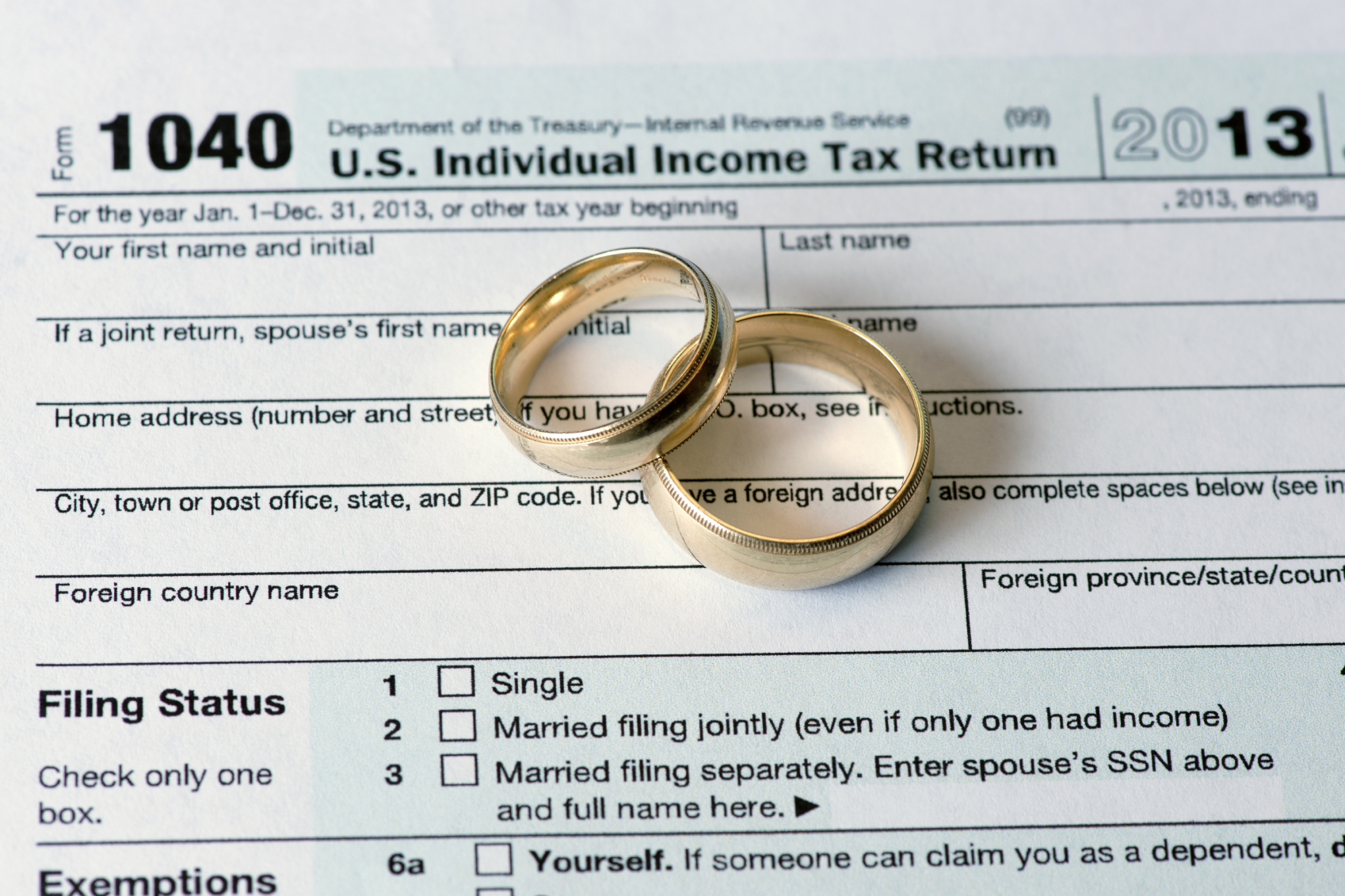
Married couples have the option to file jointly or separately on their federal income tax returns. The IRS strongly encourages most couples to file joint tax returns by extending several tax breaks to those who file together.

If you file jointly, you’re affected by your spouse’s income, deductions, and other tax items. If you file separately, you may run into reduced tax credits, such as the child and dependent care credit, and you can’t claim the standard deduction unless your spouse does the same. 

Couples who file separately receive few tax considerations. Separate tax returns may give you a higher tax with a higher tax rate. The standard deduction for separate filers is far lower than that offered to joint filers.

A marriage penalty exists when two individuals filing a joint return pay more tax than the sum of their individual tax liabilities calculated as if they were filing as single taxpayers. One reason this occurs is because the MFJ (Married Filing Joint) income tax brackets and standard deduction are not always equal to twice the single income tax bracket and standard deduction.

Couples in which one spouse earns all or most of a couple’s income rarely incur a marriage penalty, and almost always receive a marriage bonus because joint filing shifts the higher earner’s income into a lower tax bracket. Couples can benefit from filing separately if there’s a big disparity in their respective incomes, and the lower-paid spouse is eligible for substantial itemizable deductions.

Most of the time it makes more sense to file a joint tax return, but there are times when filing separate may make sense for you. If you’d like to discuss your specific situation, or learn more, please give us a call at 248-934-0550.


     

    Freelancing and Taxes: Plan for them

    Freelancer is a term we see a lot these days and the tax implications are different than as an employee. An employee has the luxury of their employer withholding and paying their tax to the appropriate taxing authorities on their behalf. A freelancer does not. In its simplest form a freelancer is a sole proprietor for income tax purposes. Becoming self-employed as a freelancer comes with great flexibility of being your own boss but one should be mindful of proper record keeping requirements and timely tax payments.

    Like-kind Exchanges: Tax Deferred Gains

    Like-kind exchanges are most popularly thought of exchanges of real estate under current law. Exchanging property is also a strategic way to dispose of property tax fee. Under the 2017 Tax Cuts and Jobs Act (TCJA) exchanges of personal property and intangible personal...

    Ask a CPA: FREE Individual Tax Planning Course

    Ever wondered if you could reduce your tax liability or pay less tax on your income? Come join us for a FREE Q&A course related to individual income tax planning. It's an opportunity to get your questions answered or hear ideas and questions from others that may...

    Tax Scams: Be Careful, They Exist

    As year-end approaches, we want to remind our friends and clients of potential tax scams that exist. Cyber criminals use these scams to obtain names, social security numbers, addresses and other personally identifiable information to file bogus tax returns or defraud...

    Foreign Bank and Financial Accounts: Understanding the FBAR

    Did you know that a taxpayer must report certain foreign financial accounts, such as bank accounts, brokerage accounts and mutual funds each year, as part of the Bank Secrecy Act? By filing a Report of Foreign Bank and Financial Accounts, otherwise known as FBAR (on...

    5 Things to Put on Your Year End Checklist

    It's important to keep a checklist of items on your financial radar as we approach the close of 2019. Below are 5 simple tax savings strategies, which will protect your financial health and ensure future success as you move into 2020. The Top 5 Year End Items: Speak...

    IRS Penalties: Abatement & Resolution

    Have you ever paid an IRS penalty or feel like you've accumulated too many penalty notices from the IRS? If so, it's possible we can help alleviate the pain. Let's review a couple of ways to reduce, remove or abate some of those penalties. There are many forms of...

    Comprehensive Financial Planning: Building a Dream Team of Professionals

    Building a network of well-connected financial professionals is a crucial means of personal wealth management. A dream team of experts will provide service and support towards working for and achieving your financial goals, while monitoring progress along the way....

    Welcome to the Senter, CPA Team – Kylie N. Harig

    Hi there! My name is Kylie Harig and I am the new office manager at Senter, CPA. I am so thankful for the opportunity to introduce myself to you and hope that you enjoy learning a little about me and my family.  I come to you with nearly a decade of experience in the...

    Workplace Dependent Care Benefits

    If you have paid for the care of your dependent(s) in the past and anticipate that dependent care will likely continue through 2020, then you will want to think about a specific work place benefit that may be available through your employer. Dependent Care Benefits,...

    Always remember, Senter, CPA is here for you if you need any assistance.

    Don't hesitate to give us a call at 248-934-0550, or contact us below.

    New Schedule C Excel Worksheet For 2025

    If you file Schedule C as a sole proprietor or single-member LLC, you already know how detailed the IRS can be. The form requires a thorough breakdown of your business income and expenses, leaving little room for guesswork. Schedule C is the primary IRS form used to report your business’s profit or loss and completing it accurately is essential for both compliance and tax planning.

    New Schedule E Excel Worksheet For 2025

    If you report rental income on Schedule E, you already know the IRS wants your numbers broken out by category and by property. Schedule E is the main IRS form used to report rental real estate income and expenses on your personal return, and clean detail makes prep faster and cuts down on follow-ups.

    Help Us Keep Spreading the Senter CPA Magic!

    First off—thank you for being part of the Senter, CPA, P.C. family! Whether we helped untangle your taxes, guided your business through accounting complexities, or simply answered that one stubborn finance question that was bugging you, we hope we’ve made your financial life a little easier (and maybe even a little brighter!). Now, we’re turning to you—not for more numbers or forms—but for just a few kind words.

    Preparing for 2025: Senter CPA Explains Key Tax Law Changes Affecting Social Security

    Recent tax legislation has introduced changes that may impact how Social Security benefits are taxed—especially for seniors with lower to moderate incomes. While the core rules around taxation of Social Security remain in place, new deductions and adjustments could offer relief for many retirees.

    1099 Season Is Coming – Don’t Wait Until Last Minute!

    It’s almost that time of year again — 1099 season! Before you start panicking and digging through piles of receipts, let’s go over a few quick reminders to make sure your 1099s are accurate and filed on time.

    Key Tax Changes for 2025: What Small Business Owners Need to Know

    Some big tax updates are coming in 2025 that can help small and mid-sized businesses save money—especially when it comes to buying equipment, investing in growth, and planning for taxes. Here’s what you need to know:

    Should You Still Itemize in 2025? Understanding the New Deduction Rules

    The new tax law—officially known as the One Big Beautiful Bill Act (OBBBA)—brings several important updates starting in 2025. One of the biggest changes? A significantly larger standard deduction, which could lower your tax bill.

    But should you still consider itemizing your deductions? Let’s break it down.

    2025 Tax Planning: Start the Year with a Smart Strategy

    As 2025 approaches, it’s the ideal time to review your tax situation, address potential shortfalls, and uncover new planning opportunities.

    How an IRS Account Can Be Useful

    At Senter CPA, we’re always looking for ways to help you take more control over your finances—with less stress. One of the best tools available today? Your own IRS Online Account.

    She Counted, She Conquered, She’s Now a CPA!

    We are proud to announce that Tracy Sanda has officially passed the Uniform Certified Public Accountant (CPA) Examination—a significant milestone in her professional career.