

Foreign Bank and Financial Accounts: Understanding the FBAR

by | Nov 18, 2019 | Internal Revenue Service, Tax

Did you know that a taxpayer must report certain foreign financial accounts, such as bank accounts, brokerage accounts and mutual funds each year, as part of the Bank Secrecy Act?

By filing a Report of Foreign Bank and Financial Accounts, otherwise known as FBAR (on FinCEN Form 114), to the IRS, you are ensuring that delinquencies are kept to a minimum while maximizing the accuracy of your annual reporting to the U.S. Federal Government.

Does This Apply to Me?

If you are a United States person, including a citizen, resident, corporation, partnership, limited liability company, trust and/or estate, then you must file an FBAR.

The FBAR will report the following to the IRS:

  1. A financial interest in or signature or other authority over at least one financial account located outside the United States if
  2. The aggregate value of those foreign financial accounts exceeded $10,000 at any time during the calendar year reported.

Accounts that are held at a financial institution, located outside the United States, are foreign financial accounts.

What Account Types are Excluded from the FBAR?

Foreign financial accounts that are correspondent, owned by a government entity, owned by an international financial institution, U.S. Military banking facility, held in a retirement account (including an IRA) or a trust in which you are the beneficiary do not need to be reported annually to the IRS.

What is the Deadline to file an FBAR?

The FBAR is due April 15 following of each calendar year.  However, you don’t need to request an extension to file, as you are allowed a free automatic extension until October 15, if you miss the April 15 deadline.

How do I File the FBAR?

You must file the FBAR electronically through the Financial Crimes Enforcement Network’s BSA E-Filing System.

FBAR Record Keeping 101:

The IRS requires you to keep records for five years from the due date of the filing.

Unsure what to archive? Maintaining records for each account required to be reported to the IRS is mandatory. Documentation that provides account specific information such as names on the account, account number, name/address of the financial institution, type of account and the maximum value for the year in each account is crucial.

What Penalties Exist for Delinquency?

Filing an FBAR late or not at all is a violation with the IRS and may subject you to penalties, including civil monetary penalties and/or criminal penalties. 

Current maximums, per the IRS, are as follows:
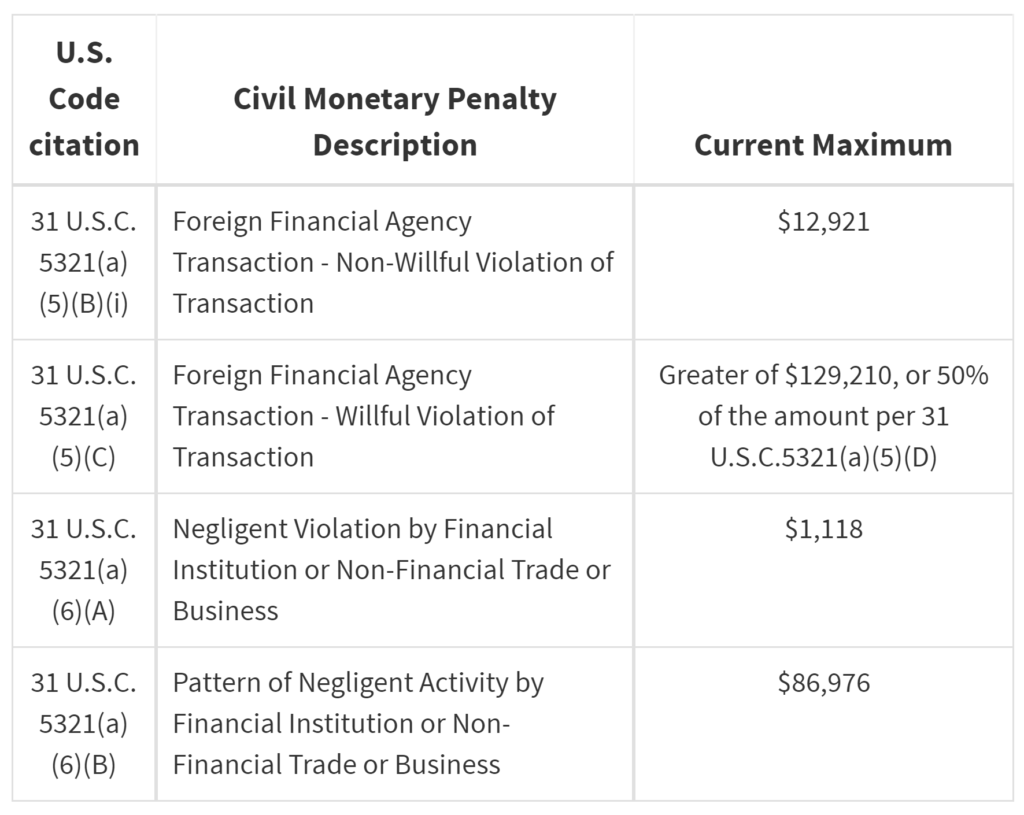
You may file late FBARs if you have not been contacted by the IRS about delinquency and are not under civil or criminal investigation by IRS.

Resources (click the links below)

If you have any questions in regards to your situation, applicability or delinquent filing, please contact us HERE or give us a call at 248-934-0550.


Disclaimer

Always remember, Senter, CPA is here for you if you need any assistance.

Don't hesitate to give us a call at 248-934-0550, or contact us below.

2025 Individual Tax Return Process

At Senter, CPA, our goal is to make your tax preparation experience as seamless and efficient as possible.

What are QCD’s?

Qualified Charitable Distributions (QCDs) are a tax-efficient way for eligible IRA owners to support charitable organizations while managing taxable income. Individuals who are age 70½ or older may donate up to $108,000 in 2025 directly from a traditional IRA to a qualified charity. When structured properly, a QCD is excluded from taxable income, may satisfy Required Minimum Distribution (RMD) requirements, and can help reduce overall tax liability.

Common Tax Documentation for 2025 Tax Season

Getting your tax documents organized for your preparer can feel overwhelming—but you don’t have to do it alone. One of the most common questions we hear is, “What documents do I need for my individual tax return?”

2025 Senter, CPA Year in Review

Reflecting on 2025, Senter CPA has experienced significant growth and success, both personally and professionally. As we roll into 2026, we’re heading into our ninth year as a firm. That’s wild. It honestly feels like just yesterday that we unlocked the doors on January 1, 2018.

URGENT: New Electronic Payment Requirements

Tax season is getting a serious tech upgrade.

New Schedule C Excel Worksheet For 2025

If you file Schedule C as a sole proprietor or single-member LLC, you already know how detailed the IRS can be. The form requires a thorough breakdown of your business income and expenses, leaving little room for guesswork. Schedule C is the primary IRS form used to report your business’s profit or loss and completing it accurately is essential for both compliance and tax planning.

New Schedule E Excel Worksheet For 2025

If you report rental income on Schedule E, you already know the IRS wants your numbers broken out by category and by property. Schedule E is the main IRS form used to report rental real estate income and expenses on your personal return, and clean detail makes prep faster and cuts down on follow-ups.

Help Us Keep Spreading the Senter CPA Magic!

First off—thank you for being part of the Senter, CPA, P.C. family! Whether we helped untangle your taxes, guided your business through accounting complexities, or simply answered that one stubborn finance question that was bugging you, we hope we’ve made your financial life a little easier (and maybe even a little brighter!). Now, we’re turning to you—not for more numbers or forms—but for just a few kind words.

Preparing for 2025: Senter CPA Explains Key Tax Law Changes Affecting Social Security

Recent tax legislation has introduced changes that may impact how Social Security benefits are taxed—especially for seniors with lower to moderate incomes. While the core rules around taxation of Social Security remain in place, new deductions and adjustments could offer relief for many retirees.

1099 Season Is Coming – Don’t Wait Until Last Minute!

It’s almost that time of year again — 1099 season! Before you start panicking and digging through piles of receipts, let’s go over a few quick reminders to make sure your 1099s are accurate and filed on time.