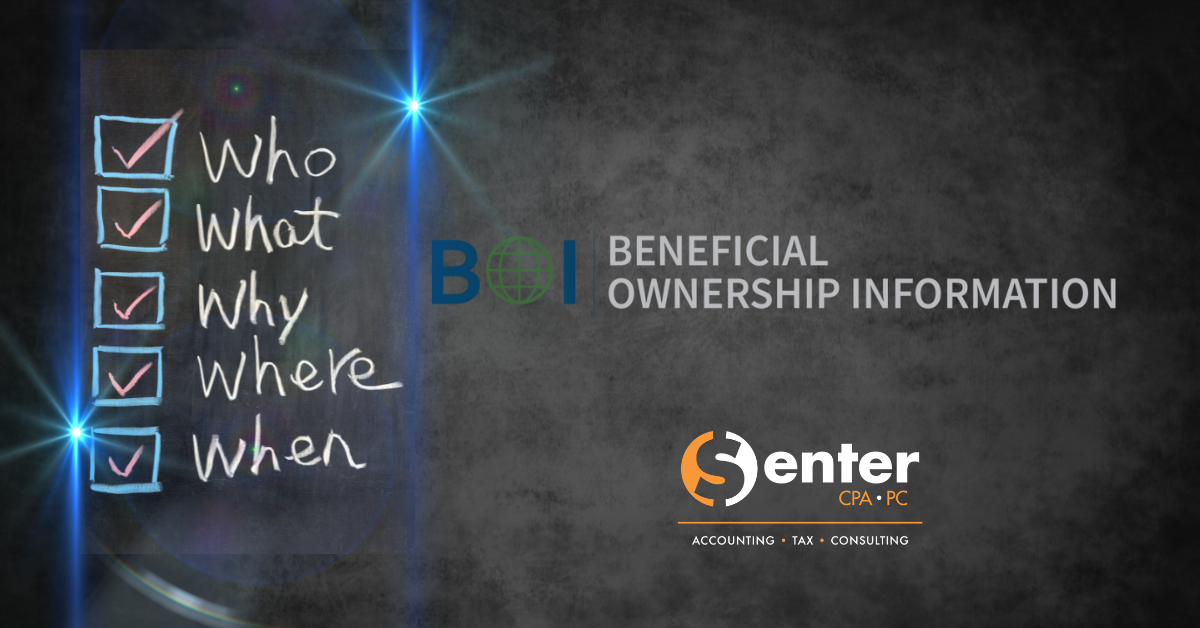
Beneficial Ownership Information Reporting, what is it?

by | Jan 5, 2024 | Tax

There is a new reporting requirement beginning January 1st, 2024, and most businesses are now required to report. What is the beneficial ownership information report, or BOI? It is a reporting requirement that came from a law passed by Congress in 2021, that will basically list who has ownership both directly and indirectly in most businesses. What this law has done is it basically prevents people from hiding their ownership.  The financial crimes enforcement network, otherwise known as FinCEN, is the department of the US Government that is responsible for enforcement and monitoring these reports.

While most businesses are required to report, there are a few types of businesses that are exempt from having to complete the BOI report. Those that are exempt include foreign businesses that are not registered to do business in and US State or jurisdiction, or any company that was created and did not  file any document with the secretary of state or any similar office under the law of a state or Indian tribe. A few other businesses that are excluded, include banks, credit unions, accounting firms, public utilities, insurance companies, investment companies, tax-exempt entities & inactive entities. For a full list of entities that are excluded from having to report, please visit https://www.fincen.gov/boi

So now that you qualify, you may be wondering what and how do you report. All reporting companies have to report its beneficial owners. This is anyone who directly or indirectly owns or controls 25% or more of the ownership interests or anyone who has substantial control over the company. Some examples of ownership interests are equity, stock, capital and profit interests, options & privileges and convertible instruments. Exceptions to beneficial owners are minor children (parents must instead be reported), nominees, custodians or agents of another individual, employees if they are not a senior officer and do not have substantial control over their job, creditors and inheritors who’s only interest is in the future or to satisfy a loan or debt.

If your business was created on or after January 1st 2024, you will have 90 days to complete your report once registered. If your business was created on or after January 1st, 2025, you will have 30 days to complete your report once registered. In addition, you will have to report company applicants. Businesses created before January 1st, 2024, do not have to report company applicants. The company applicants are the people who were responsible or directly filed the documents with the secretary of state or similar office that created the company that is reporting.

For businesses created before January 1st 2024 that must report, it must be completed before January 1st, 2025. There is no cost to report, but failure to report can result in civil and criminal penalties. The report can only be completed through the FinCEN’s online filing system. The system is still being developed, and once released the FinCEN will release instructions and guidance on how to use this system on their website https://www.fincen.gov/boi.

Please, feel free to reach out to us with any questions. We can be reached at (248) 934-0550. Or you can contact below.

Always remember, Senter, CPA is here for you if you need any assistance.

Don't hesitate to give us a call at 248-934-0550, or contact us below.

Tax Extensions for 2025 Returns: What Current Clients Need to Know

First, let’s be clear

A tax extension gives you more time to file. It does not give you more time to pay.

Beware of the Latest IRS Impersonation Scam

IRS impersonation scams are becoming more sophisticated. The newest trend involves fraudulent IRS communications – delivered via email, phone calls, or even seemingly official mail – that attempt to intimidate individuals into providing personal information or making payments.

How Senter CPA Helps You Stay Organized, Compliant, and Confident

Accurate record-keeping, strong organizational habits, and effective use of accounting software are essential pillars of sound financial management. Whether managing a small business, a nonprofit, or personal finances, these practices not only ensure compliance with legal and regulatory requirements but also support smarter decision-making and long-term financial health.

National Reading Month at Senter, CPA 

March is National Reading Month, and it’s a reminder of something simple but incredibly powerful: books change lives.

Most of us can remember our favorite childhood story. You know the one we asked to hear again and again before bedtime, or the book that first made reading feel fun instead of like homework. Those early moments matter more than we often realize. They help children build confidence, curiosity, and a lifelong love of learning.

That’s one of the reasons Senter, CPA has chosen to support the Dolly Parton’s Imagination Library.

A Day in the Life of a CPA During Tax Season (Please Send Snacks)

If you’ve ever wondered what happens after you drop off your tax documents, here’s a little behind-the-scenes look at life inside a small CPA firm during tax season.

Sharing Online Banking with Your Accountant

To allow your accountant access to your bank’s online banking system, follow these general steps. This typically involves navigating to a “User Management” or “Account Access” section, where you can add a new user and set permissions—usually “view-only” for accountants.

The 7 Deadly (Tax) Sins of Small Business Owners

Running a business is hard enough — between serving customers, managing staff, and juggling invoices, your taxes can feel like an afterthought. But beware, small business owner: the IRS has seen it all, and a few “little” mistakes can cost you big.

What the New “No Tax on Tips” Rule Means for You

The treatment of tip income is changing in 2025, thanks to the new “No Tax on Tips” provision introduced under the One Big Beautiful Bill Act (OBBBA). While tips remain taxable in several respects, eligible workers may now claim a federal income tax deduction of up to $25,000 annually for “qualified tips.”

Why QuickBooks Can’t Replace Your Accountant (Even If It Thinks It Can)

Let’s face it — QuickBooks is amazing. It’s like the Swiss Army knife of bookkeeping. It tracks your income, pays your bills, and even sends friendly reminders that you forgot to reconcile your bank account… again. But while QuickBooks can do a lot, it can’t do everything — especially the things that can make or save you money. And that’s where your accountant (hi, that’s us) comes in.

Business Mileage Deductibility: What Qualifies and What Does Not

Vehicle expenses can be a valuable tax deduction, but only when mileage is properly classified and documented. For tax purposes, the deductibility of mileage depends on whether the travel is considered business, commuting, or personal. Understanding these distinctions is essential to support allowable business mileage deductions.