
Traditional vs. Roth IRAs

by | Feb 13, 2024 | Tax

Saving for retirement can be a daunting task. Here, at Senter CPA, we can help you make some of those retirement decisions. One of those being the decision to put money into a Traditional retirement account or a Roth account. Everyone has a different tax situation from year to year so there is no correct answer to which one is better.

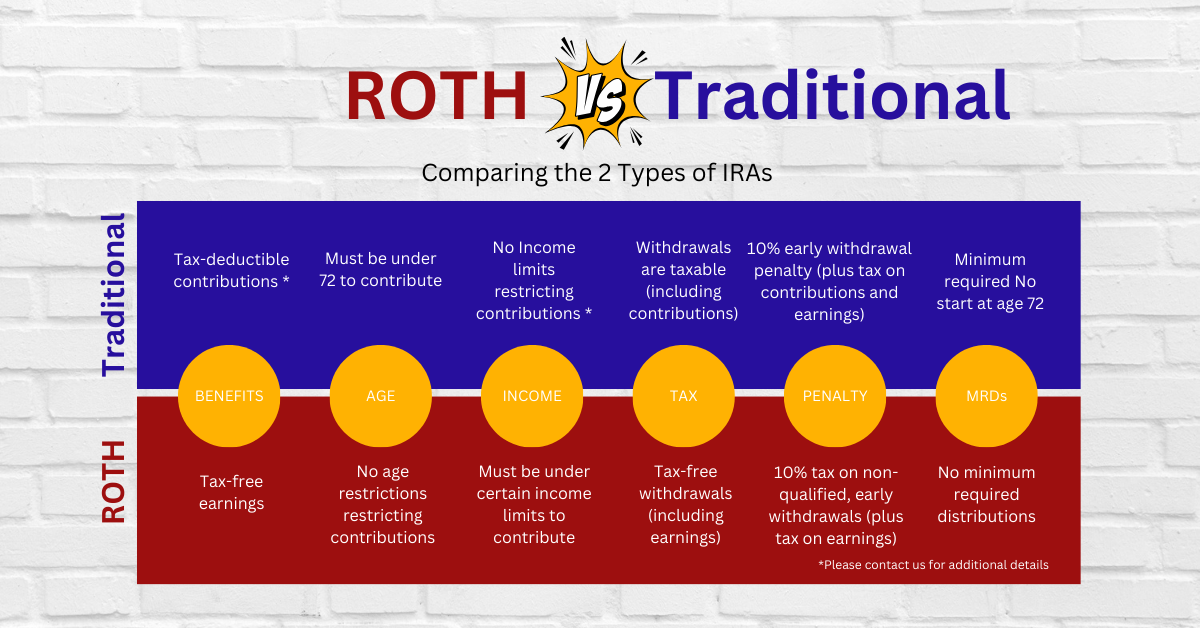
Traditional retirement is put into your account before you pay taxes on it. This helps lower your taxes due in the current year and allows your account to make a higher contribution. The negative of this type of account is that you will have to pay taxes on it when you pull the money out of the account. Traditional retirement accounts are also subject to RMD’s (required minimum distributions). This is a required distribution that starts when you turn 72.

Roth accounts have their contributions added after tax. This means there is no tax benefit in the current year, but the accounts will not be taxed again if you make qualified distributions. These accounts are not subject to RMD’s because they have already been taxed. So, the taxes are paid up front and the account grows tax free.

Now that you know the differences in the accounts, we will discuss some of the strategy applied to deciding. You will want to be taxed in the lowest tax brackets possible between the accounts. This means that if you are just starting your career and are in a lower tax bracket it could be a good time to contribute to a Roth account because you can get it into the account at a relatively lower tax rate. On the other hand, if you are having an amazing year and got raises and bonuses it might be a good year to contribute to a traditional account and have the tax benefit in the current year. This will allow you to pay taxes on that contribution later when you take a distribution when you are older and pssibly have a lower tax rate.

You have to look at these things from year to year. It’s not just a one-time thing. You might switch back and forth between the two or you might not be so certain about the future and want to split contributions into both so that you may have some flexibility when it comes to retirement planning. Other things to consider when thinking about retirement planning are that there are income limits to contributing to a Roth plan but there are ways to roll traditional accounts into Roths. If you have further questions about these, you can contact us or your financial advisors.


Always remember, Senter, CPA is here for you if you need any assistance.

Don't hesitate to give us a call at 248-934-0550, or contact us below.

National Reading Month at Senter, CPA 

March is National Reading Month, and it’s a reminder of something simple but incredibly powerful: books change lives.

Most of us can remember our favorite childhood story. You know the one we asked to hear again and again before bedtime, or the book that first made reading feel fun instead of like homework. Those early moments matter more than we often realize. They help children build confidence, curiosity, and a lifelong love of learning.

That’s one of the reasons Senter, CPA has chosen to support the Dolly Parton’s Imagination Library.

A Day in the Life of a CPA During Tax Season (Please Send Snacks)

If you’ve ever wondered what happens after you drop off your tax documents, here’s a little behind-the-scenes look at life inside a small CPA firm during tax season.

Sharing Online Banking with Your Accountant

To allow your accountant access to your bank’s online banking system, follow these general steps. This typically involves navigating to a “User Management” or “Account Access” section, where you can add a new user and set permissions—usually “view-only” for accountants.

The 7 Deadly (Tax) Sins of Small Business Owners

Running a business is hard enough — between serving customers, managing staff, and juggling invoices, your taxes can feel like an afterthought. But beware, small business owner: the IRS has seen it all, and a few “little” mistakes can cost you big.

What the New “No Tax on Tips” Rule Means for You

The treatment of tip income is changing in 2025, thanks to the new “No Tax on Tips” provision introduced under the One Big Beautiful Bill Act (OBBBA). While tips remain taxable in several respects, eligible workers may now claim a federal income tax deduction of up to $25,000 annually for “qualified tips.”

Why QuickBooks Can’t Replace Your Accountant (Even If It Thinks It Can)

Let’s face it — QuickBooks is amazing. It’s like the Swiss Army knife of bookkeeping. It tracks your income, pays your bills, and even sends friendly reminders that you forgot to reconcile your bank account… again. But while QuickBooks can do a lot, it can’t do everything — especially the things that can make or save you money. And that’s where your accountant (hi, that’s us) comes in.

Business Mileage Deductibility: What Qualifies and What Does Not

Vehicle expenses can be a valuable tax deduction, but only when mileage is properly classified and documented. For tax purposes, the deductibility of mileage depends on whether the travel is considered business, commuting, or personal. Understanding these distinctions is essential to support allowable business mileage deductions.

Welcome to the Senter, CPA Team – Shannon Currie

Shannon is pleased to join the Senter team as a Staff Accountant.

How to Document Charitable Donations for Tax Deductions

Accurate documentation is essential when claiming charitable contributions on your tax return. The IRS requires specific records depending on the type and value of your donations. Maintaining proper records ensures your contributions are deductible and helps you avoid issues if your return is ever reviewed.

How to make Federal & State Income Tax Payments (update January 2026)

Paying federal and Michigan income taxes is pretty straightforward and are now required to be paid online.