

Foreign Bank and Financial Accounts: Understanding the FBAR

by | Nov 18, 2019 | Internal Revenue Service, Tax

Did you know that a taxpayer must report certain foreign financial accounts, such as bank accounts, brokerage accounts and mutual funds each year, as part of the Bank Secrecy Act?

By filing a Report of Foreign Bank and Financial Accounts, otherwise known as FBAR (on FinCEN Form 114), to the IRS, you are ensuring that delinquencies are kept to a minimum while maximizing the accuracy of your annual reporting to the U.S. Federal Government.

Does This Apply to Me?

If you are a United States person, including a citizen, resident, corporation, partnership, limited liability company, trust and/or estate, then you must file an FBAR.

The FBAR will report the following to the IRS:

  1. A financial interest in or signature or other authority over at least one financial account located outside the United States if
  2. The aggregate value of those foreign financial accounts exceeded $10,000 at any time during the calendar year reported.

Accounts that are held at a financial institution, located outside the United States, are foreign financial accounts.

What Account Types are Excluded from the FBAR?

Foreign financial accounts that are correspondent, owned by a government entity, owned by an international financial institution, U.S. Military banking facility, held in a retirement account (including an IRA) or a trust in which you are the beneficiary do not need to be reported annually to the IRS.

What is the Deadline to file an FBAR?

The FBAR is due April 15 following of each calendar year.  However, you don’t need to request an extension to file, as you are allowed a free automatic extension until October 15, if you miss the April 15 deadline.

How do I File the FBAR?

You must file the FBAR electronically through the Financial Crimes Enforcement Network’s BSA E-Filing System.

FBAR Record Keeping 101:

The IRS requires you to keep records for five years from the due date of the filing.

Unsure what to archive? Maintaining records for each account required to be reported to the IRS is mandatory. Documentation that provides account specific information such as names on the account, account number, name/address of the financial institution, type of account and the maximum value for the year in each account is crucial.

What Penalties Exist for Delinquency?

Filing an FBAR late or not at all is a violation with the IRS and may subject you to penalties, including civil monetary penalties and/or criminal penalties. 

Current maximums, per the IRS, are as follows:
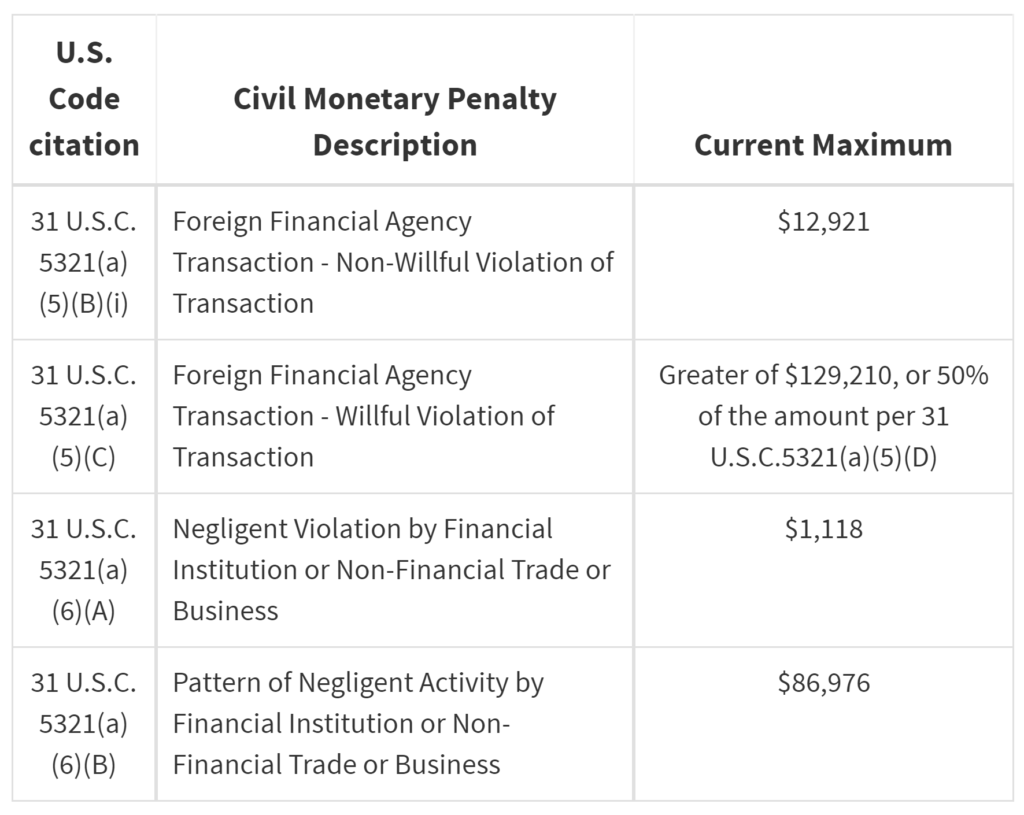
You may file late FBARs if you have not been contacted by the IRS about delinquency and are not under civil or criminal investigation by IRS.

Resources (click the links below)

If you have any questions in regards to your situation, applicability or delinquent filing, please contact us HERE or give us a call at 248-934-0550.


Disclaimer

Always remember, Senter, CPA is here for you if you need any assistance.

Don't hesitate to give us a call at 248-934-0550, or contact us below.

2026 Clarkston Rotary Wine Party: Come Hang Out With Us

I can think of worse ways to help local kids than spending a Thursday night eating, drinking, bidding on stuff you probably do not need, and hanging out with 350 to 450 of your favorite Clarkston friends.

Planning Ahead: Small Steps That Can Save Big Later

Even in the middle of tax season, it’s not too late to make moves that can save your business money and headaches down the line. Many business owners get caught up in the day-to-day and wait until the very end to think about taxes. The truth is, a few small steps now can make a big difference later.

Keep Your Receipts Nearby and Organized

Business owners understand that receipts are everywhere and also can seemingly end up nowhere to be found.

Are Unused Subscriptions Costing You Money?

As household expenses continue to rise, identifying unnecessary recurring charges is a practical way to improve cash flow without making significant lifestyle changes. Many consumers unknowingly pay for subscriptions they no longer use, forgot to cancel after a free trial, or no longer find valuable. While individual charges may seem insignificant, the combined annual cost can amount to hundreds of dollars.

Your Year-End Tax Bill Shouldn’t Be a Surprise

December has a way of making tax planning feel urgent—but by December, you’re already behind the strategy and some of the best planning opportunities could have already passed you.

Fall Accounting

It’s like spring cleaning, but now we’re working on it in between Back to School and Football and Pumpkins and Mostly Great Weather!

Trump Accounts: What Parents—Especially Michigan Families—Need to Know

Trump Accounts are a new type of savings vehicle designed to help families build long-term financial resources for children. Structured as a special type of traditional IRA, these accounts have specific rules governing eligibility, contributions, investments, and withdrawals.

Senter Forward: The Kind of Client Relationship We Want to Build

I will start with something that may sound strange coming from a CPA firm: we are not trying to take every piece of work that walks through the door.
We have reached a point where the question is less “Can we prepare this return?” and more “Can we build a relationship here where our team can actually help?” That difference matters.

Federal Updates on Tip And Overtime Tax Deductions

Recent federal tax legislation introduced new deductions related to qualified tip income and overtime pay. These changes may benefit eligible employees while also creating additional reporting responsibilities for employers. At Senter CPA, we are helping both businesses and individual taxpayers understand how these rules apply and how to stay compliant.

1099 Filing Requirements Update! Yes, this is good news!

The reporting amount threshold has increased. Yes, you read that right! The old $600 filing requirement for 1099-MISC & 1099-NECs has been increased to $2,000, with some minor exceptions.

To jog your memory, if you need it, you are required to file 1099s to those who you pay for rent, contract labor (not through your payroll), interest, etc. The 1099-MISC is most commonly used to report rent, while the 1099-NEC is mostly used to report non-employee compensation to most everyone.