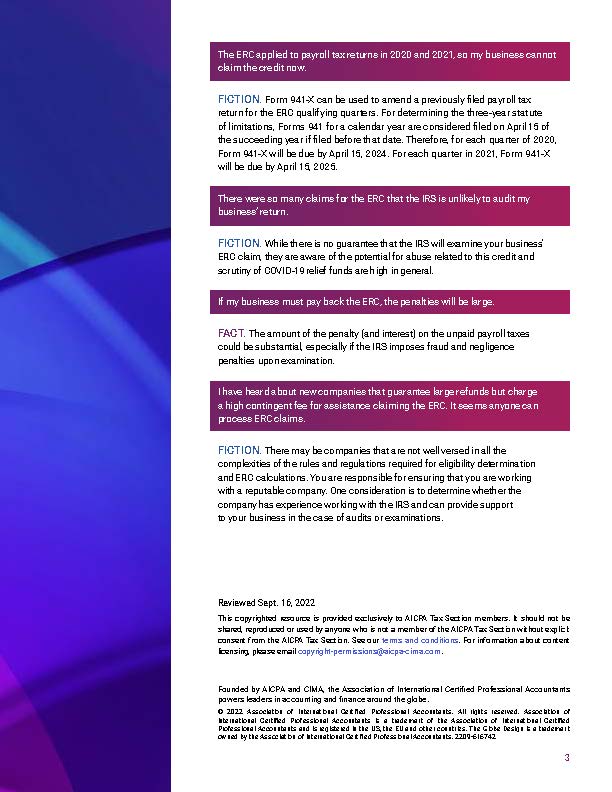
There are many people who may have question regarding the Employee Retention Credit (ERC) that became available for businesses during the Covid-19 pandemic. Below is a helpful article to decifer the facts about the ERC. As always, Senter, CPA is here to help. If you have more questions, please reach out to us.
Fact or Fiction for the Employee Retention Credit (ERC)
by Josh Legant | Nov 30, 2022 | Accounting, Courses, Internal Revenue Service, Tax

Always remember, Senter, CPA is here for you if you need any assistance.
Don't hesitate to give us a call at 248-934-0550, or contact us below.
How to make Federal & State Income Tax Payments (update January 2026)
by Matthew Senter | January 23, 2026 | Accounting, Tax | 0 Comments
Paying federal and Michigan income taxes is pretty straightforward and are now required to be paid online.
2025 Individual Tax Return Process
by Lisa Haiss | January 22, 2026 | Tax, Team | 0 Comments
At Senter, CPA, our goal is to make your tax preparation experience as seamless and efficient as possible.
What are QCD’s?
by Tracy Sanda | January 20, 2026 | Internal Revenue Service, Tax | 0 Comments
Qualified Charitable Distributions (QCDs) are a tax-efficient way for eligible IRA owners to support charitable organizations while managing taxable income. Individuals who are age 70½ or older may donate up to $108,000 in 2025 directly from a traditional IRA to a qualified charity. When structured properly, a QCD is excluded from taxable income, may satisfy Required Minimum Distribution (RMD) requirements, and can help reduce overall tax liability.
Common Tax Documentation for 2025 Tax Season
by Lisa Haiss | January 13, 2026 | Internal Revenue Service, Tax | 0 Comments
Getting your tax documents organized for your preparer can feel overwhelming—but you don’t have to do it alone. One of the most common questions we hear is, “What documents do I need for my individual tax return?”
2025 Senter, CPA Year in Review
by Matthew Senter | January 7, 2026 | Accounting, Tax | 0 Comments
Reflecting on 2025, Senter CPA has experienced significant growth and success, both personally and professionally. As we roll into 2026, we’re heading into our ninth year as a firm. That’s wild. It honestly feels like just yesterday that we unlocked the doors on January 1, 2018.
URGENT: New Electronic Payment Requirements
by Jordan Middleton | January 7, 2026 | Accounting, Tax | 0 Comments
Tax season is getting a serious tech upgrade.
New Schedule C Excel Worksheet For 2025
by Matthew Senter | December 23, 2025 | Accounting, Tax | 0 Comments
If you file Schedule C as a sole proprietor or single-member LLC, you already know how detailed the IRS can be. The form requires a thorough breakdown of your business income and expenses, leaving little room for guesswork. Schedule C is the primary IRS form used to report your business’s profit or loss and completing it accurately is essential for both compliance and tax planning.
New Schedule E Excel Worksheet For 2025
by Matthew Senter | December 23, 2025 | Accounting, Tax | 0 Comments
If you report rental income on Schedule E, you already know the IRS wants your numbers broken out by category and by property. Schedule E is the main IRS form used to report rental real estate income and expenses on your personal return, and clean detail makes prep faster and cuts down on follow-ups.
Help Us Keep Spreading the Senter CPA Magic!
by Matthew Senter | December 15, 2025 | Accounting, Tax | 0 Comments
First off—thank you for being part of the Senter, CPA, P.C. family! Whether we helped untangle your taxes, guided your business through accounting complexities, or simply answered that one stubborn finance question that was bugging you, we hope we’ve made your financial life a little easier (and maybe even a little brighter!). Now, we’re turning to you—not for more numbers or forms—but for just a few kind words.
Preparing for 2025: Senter CPA Explains Key Tax Law Changes Affecting Social Security
by Tracy Sanda | December 1, 2025 | Accounting, Tax | 0 Comments
Recent tax legislation has introduced changes that may impact how Social Security benefits are taxed—especially for seniors with lower to moderate incomes. While the core rules around taxation of Social Security remain in place, new deductions and adjustments could offer relief for many retirees.