
Who we work best with, what the process looks like, and why the right fit matters on both sides.
I will start with something that may sound strange coming from a CPA firm: we are not trying to take every piece of work that walks through the door.
We have reached a point where the question is less “Can we prepare this return?” and more “Can we build a relationship here where our team can actually help?” That difference matters.
Tax returns are important. Compliance work matters. But if the only time we talk is when a deadline is breathing down everyone’s neck, we are usually showing up too late to do our best work. Senter Forward is our answer to that.
|
Senter Forward is built for business owners who want their accounting, tax, and advisory work connected, current, and useful.
|
So, Who is a Senter Forward Client?
The best fit is not defined by revenue, number of employees, or some magic threshold. We work with businesses ranging from startups to companies approaching $25 million in revenue. What matters more is the owner.
We work best with business owners who care about how the business runs. They want clean information. They ask questions. They want to improve the operation, make better decisions, reduce surprises, and spend their own time on the work that creates the most value.
They do not have to be obsessed with getting bigger. A business can stay the same size and still become more profitable, more organized, easier to manage, less dependent on the owner, and far more valuable if it is ever sold.
What we are looking for is commitment. We want clients who want us on their team, not clients who simply need somebody, anybody, to file a form.
Our Three Starting Requirements
For most new Senter Forward relationships, three things need to be true. There is some flexibility, but these are the guardrails that let us do better work.
- We need a meaningful role in the accounting function
We need current accounting records we can trust and use for planning. In many cases, our team handles the bookkeeping and month-end close. In others, a strong internal bookkeeper or controller handles the day-to-day work and we provide month-end or quarterly review and oversight.
The exact setup can vary. The point is the same: current, accurate accounting records allow us to provide timely and meaningful tax and business guidance.
- We meet at least once a year
At a minimum, we want one meaningful meeting each year, either in person or by video. Often that meeting is tied to the annual tax return review.
Yes, we review what happened on the return and how the business return connects to the owner’s personal return. But the meeting has another purpose. It gives us room to talk about what is working, what is not, what you do not understand, what you wish we did differently, and what you may need next.
I would much rather hear, “Matt, this part of the process drives me nuts,” while you are still sitting across the table from me than have you explain it six months later to another CPA.
- Compliance is typically part of the relationship too
For most Senter Forward clients, we prepare the business and individual income tax returns. That is still the reason many people call us in the first place, and it is a major part of seeing the full picture.
That said, this is not an absolute rule. We will consider accounting-only relationships where another qualified professional prepares the returns, provided the arrangement works and the roles are clear.
We also still take on some compliance-only work. We evaluate compliance only engagements carefully to ensure the relationship is a good fit for both the client and our firm. Our focus is on relationships that allow us to provide consistent support throughout the year; while still offering select compliance only services when they align with our capacity and expertise.
Additional Services Tailored to Your Needs
This is where Senter Forward becomes tailored to each client. We build the scope around your goals, priorities, and the level of support that will provide the most value.
- Sales tax and personal property tax filings
- Flow-through entity withholding and related state filings
- Annual, semiannual, or quarterly tax projections
- Prepared or compiled financial statements
- 1099 preparation
- Monthly, quarterly, or semiannual strategy meetings
- Coaching calls and decision support
- Custom KPI design and reporting
- Budgeting and forecasting
- Video walkthroughs of tax returns or monthly financial statements
- Priority response times within our highest service tier
Every client’s needs are different. Through our discovery process; we learn what you are working toward and build the scope around those goals.
The Three Senter Forward Service Levels
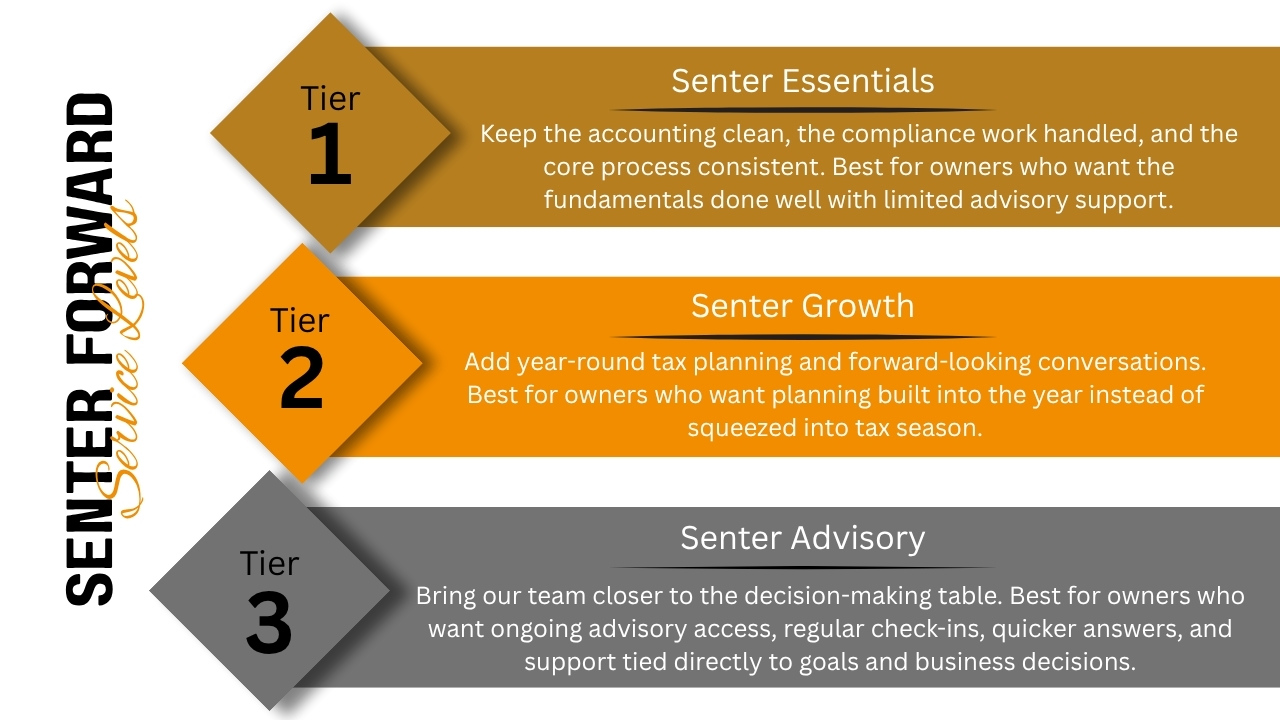
After our discovery meeting, we usually present all three options and recommend the one we believe best matches what you told us you want. If someone tells me they want regular planning, proactive advice, and quick access, then selects the lowest-touch option simply because it is cheaper, that is something we need to talk about. The scope should match the relationship you actually want.
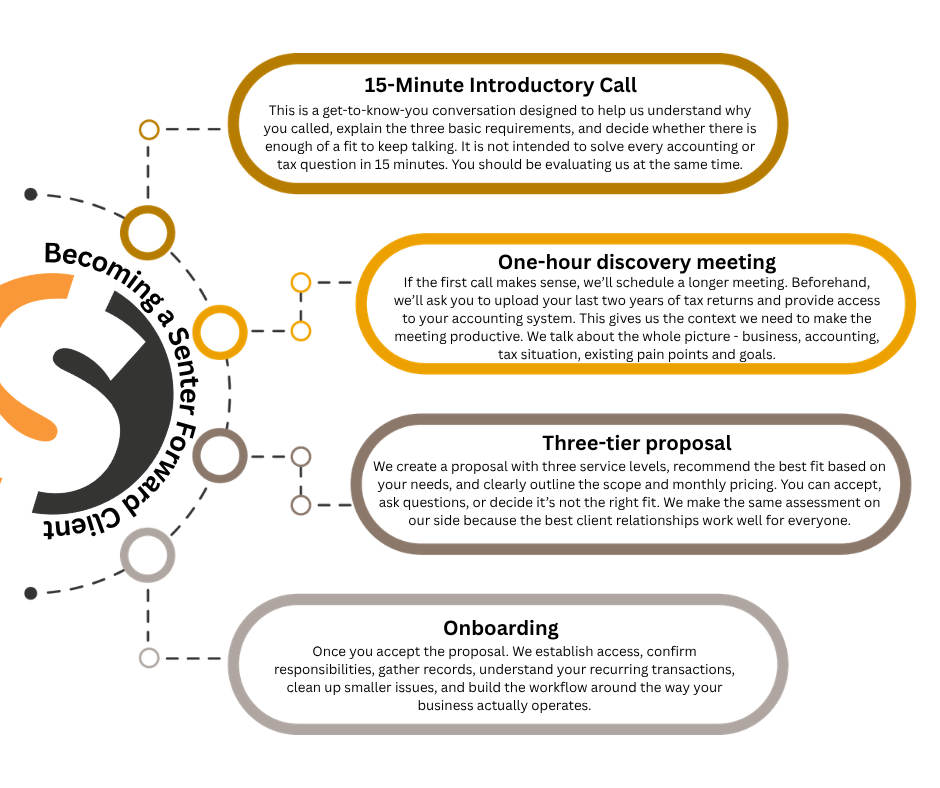
What the process looks like before you ever become a client
The first few months are where we learn how your business works
There is almost always a learning curve. We need to understand your transactions, how money moves through the business, who does what, what reports matter, and which transactions deserve a closer look.
We also work to reduce the amount of information you have to manually gather and deliver. Read-only bank access, accountant access to systems, recurring document requests, direct payroll access, TaxDome, and standard workflows all help us get the information we need without turning the owner into a full-time courier between systems.
That is one of the less obvious benefits of a strong accounting relationship. Better process creates separation of duties, less interruption, cleaner information, and a business that is easier to hand off to a manager, partner, buyer, or future owner.
Historical cleanup may need to be completed first
We will sometimes take on cleanup work for the immediately preceding year when the timing allows us to get the books right and file accurate returns, often on extension. We generally will not take on years of old cleanup, multiple amended returns, or a long list of unresolved historical issues as the price of admission to a new relationship.
That work usually needs to be handled first. We want to start from a place where we can move forward, rather than spending the next two years working through the past.
You are hiring Senter CPA, not Matt
This one is important to me.
A Senter Forward client is hiring the Senter CPA team. I will be involved, but the value is not one person trying to personally touch every transaction, email, return, financial statement, and question. Our clients are better served by having access to the strengths and experience of the entire Senter CPA team.
Our team members bring different strengths. Accounting, tax, payroll, systems, client service, review, and advisory work overlap in ways that make the whole team stronger. The goal is for you to have access to the right person, with the right information, at the right time.
Why this model is better for you
The practical benefit is that you can spend more of your time doing the technical, operational, sales, and leadership work that actually drives your business. Meanwhile, the accounting function becomes cleaner, more consistent, and less dependent on you personally.
You get better data for tax planning. Better data for budgeting. Better data for decisions. Better separation of duties. Fewer surprises. And if you ever sell the business, a clean, repeatable back office can make the company easier for someone else to step into.
Why this model is better for us too
I would rather have a smaller group of Senter Forward clients than a giant pile of one-time transactions because this is the work we actually want to do.
We get to understand why the business exists, how the owner thinks, what matters to them, and where they are trying to go. We get to become an extension of the team instead of a name that appears once a year next to a signature block.
That work is more rewarding for us. More important, it gives us a much better chance to be useful to you.
|
The goal is simple: you should feel like Senter CPA is part of your team, not a vendor you remember to call when something is due.
|
Think this sounds like your kind of accounting relationship?
The first step is a 15-minute introductory call. We will talk through what you are looking for, explain how Senter Forward works, and decide together if it makes sense to continue to a discovery meeting.
Senter Forward is intentionally designed for business owners who value a collaborative, year-round accounting relationship. When the fit is right, we want the reaction to be simple: “Yep. I want those people on my team.”