
How to make Federal & State Income Tax Payments (update January 2026)

by | Jan 23, 2026 | Accounting, Tax

Making Your Federal & State Income Tax Payments (updated January 2026)

Paying federal and Michigan income taxes is pretty straightforward and are now required to be paid online. Below is the current list of ways to pay, plus a few tips to avoid mistakes and fees.

Federal Tax Payments (Form 1040):

  • Pay from your bank account (no fee)
    • IRS Direct Pay: Pay from checking or savings. You can also make estimated payments.
    • IRS Online Account: Pay same day or schedule up to 365 days out. You can also view up to 5 years of payment history. 
  • Pay by debit, credit card, or digital wallet (fees apply): The IRS uses approved payment processors. Fees vary by processor and payment type. 
  • IRS2Go mobile app: Use the official IRS app to check refund status and make payments from your phone. 
  • EFTPS (note for individuals): EFTPS still exists, but EFTPS indicates that new individual taxpayers must use IRS Direct Pay or IRS Online Account starting October 17, 2025 (with a broader change noted for 2026). If you already use EFTPS, expect a transition period. 
  • Payment plans (installment agreements): If you cannot pay in full, you can apply online for an IRS payment plan. 
  • Mailing a check with printed vouchers is no longer an option
    • In accordance with Executive Order 14247, Modernizing Payments To and From America’s Bank Account, signed on March 25, 2025, the U.S. Department of the Treasury, in coordination with the Internal Revenue Service and other federal agencies, is advancing the transition to fully electronic federal payments. This policy shift includes phase out of paper tax refund checks beginning Sept. 30, 2025, to the extent permitted by law.
    • The purposes of EO 14247 are to defend against financial fraud and improper payments, increase efficiency, reduce costs, and enhance the security of federal payments. Paper checks are over 16 times more likely to be lost, stolen, altered, or delayed than electronic payments. Direct deposit also avoids the possibility that a refund check could be returned to the IRS as undeliverable.


Michigan state tax payments (Form MI-1040):

    • Bank account transfer (EFT): free
    • Debit card: flat fee
    • Credit card: percentage convenience fee
  • Mail a check with a voucher
    • Our recommendation is to follow the IRS guidelines and make your payments online.
    • If you prefer to mail a payment, you can still do so HERE by printing vouchers but we highly recommend you pay them online.

Quick tips to avoid headaches

  • Save the confirmation number or receipt for any online payment. The confirmation should show the date paid, amount paid, payment type (balance due vs estimated vs extension) and the tax year the payment was applied to.
  • Double-check you picked the right payment reason (balance due vs estimated vs extension).
  • Watch for scams. Start from the IRS or Michigan Treasury payments pages, not from emailed links.

Note: Payment options and fees change. Always check the official IRS and Michigan Treasury payment pages before submitting a payment.


Always remember, Senter, CPA is here for you if you need any assistance.

Don't hesitate to give us a call at 248-934-0550, or contact us below.

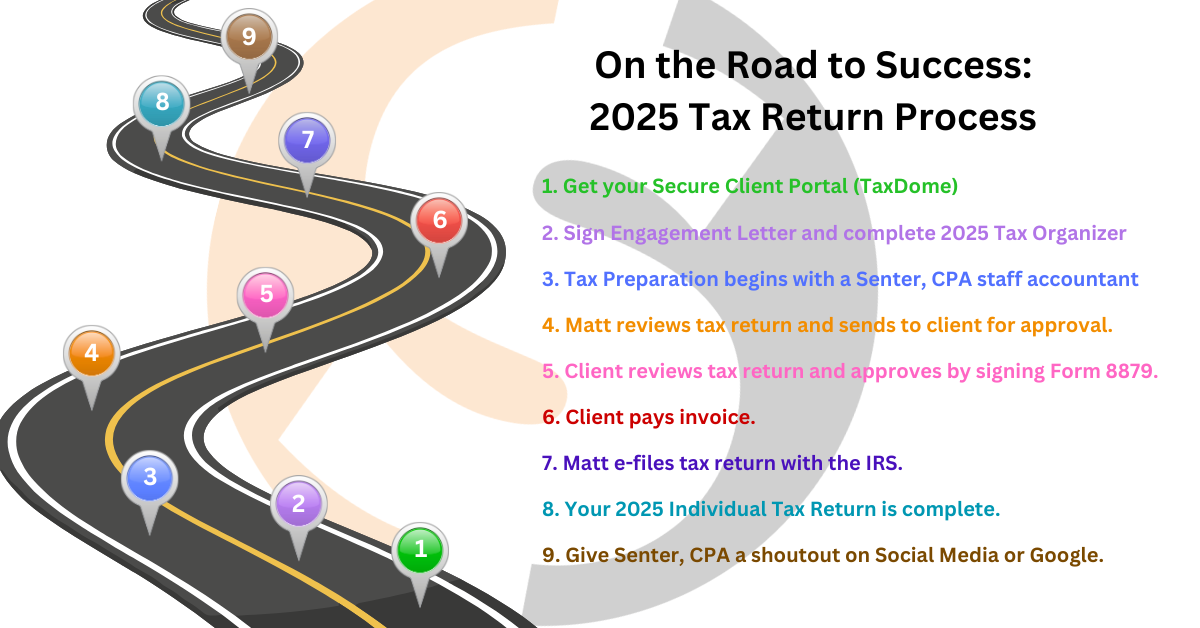
2025 Individual Tax Return Process

At Senter, CPA, our goal is to make your tax preparation experience as seamless and efficient as possible.

What are QCD’s?

Qualified Charitable Distributions (QCDs) are a tax-efficient way for eligible IRA owners to support charitable organizations while managing taxable income. Individuals who are age 70½ or older may donate up to $108,000 in 2025 directly from a traditional IRA to a qualified charity. When structured properly, a QCD is excluded from taxable income, may satisfy Required Minimum Distribution (RMD) requirements, and can help reduce overall tax liability.

Common Tax Documentation for 2025 Tax Season

Getting your tax documents organized for your preparer can feel overwhelming—but you don’t have to do it alone. One of the most common questions we hear is, “What documents do I need for my individual tax return?”

2025 Senter, CPA Year in Review

Reflecting on 2025, Senter CPA has experienced significant growth and success, both personally and professionally. As we roll into 2026, we’re heading into our ninth year as a firm. That’s wild. It honestly feels like just yesterday that we unlocked the doors on January 1, 2018.

URGENT: New Electronic Payment Requirements

Tax season is getting a serious tech upgrade.

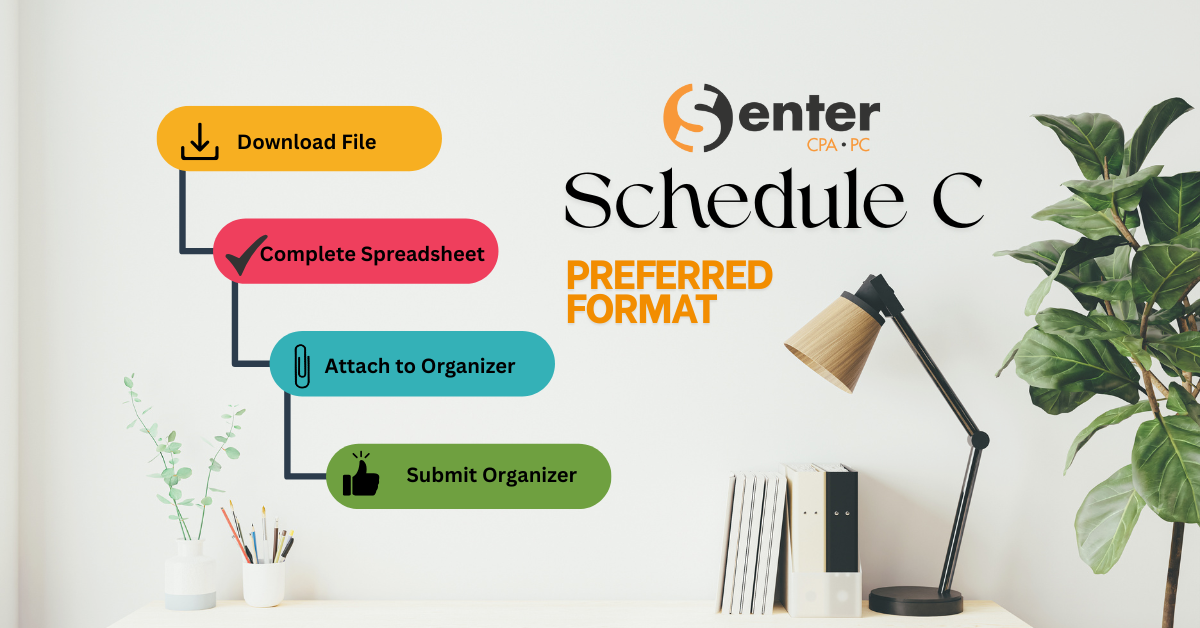
New Schedule C Excel Worksheet For 2025

If you file Schedule C as a sole proprietor or single-member LLC, you already know how detailed the IRS can be. The form requires a thorough breakdown of your business income and expenses, leaving little room for guesswork. Schedule C is the primary IRS form used to report your business’s profit or loss and completing it accurately is essential for both compliance and tax planning.

New Schedule E Excel Worksheet For 2025

If you report rental income on Schedule E, you already know the IRS wants your numbers broken out by category and by property. Schedule E is the main IRS form used to report rental real estate income and expenses on your personal return, and clean detail makes prep faster and cuts down on follow-ups.

Help Us Keep Spreading the Senter CPA Magic!

First off—thank you for being part of the Senter, CPA, P.C. family! Whether we helped untangle your taxes, guided your business through accounting complexities, or simply answered that one stubborn finance question that was bugging you, we hope we’ve made your financial life a little easier (and maybe even a little brighter!). Now, we’re turning to you—not for more numbers or forms—but for just a few kind words.

Preparing for 2025: Senter CPA Explains Key Tax Law Changes Affecting Social Security

Recent tax legislation has introduced changes that may impact how Social Security benefits are taxed—especially for seniors with lower to moderate incomes. While the core rules around taxation of Social Security remain in place, new deductions and adjustments could offer relief for many retirees.

1099 Season Is Coming – Don’t Wait Until Last Minute!

It’s almost that time of year again — 1099 season! Before you start panicking and digging through piles of receipts, let’s go over a few quick reminders to make sure your 1099s are accurate and filed on time.